LEARN THE SKY ONE PATTERN AT A TIME
Computers and motorized GoTo handsets can point a telescope directly at thousands of deep-sky targets, but they cannot teach you where you stand beneath the universe. True fluency with the night sky comes from learning the naked-eye anchor stars, deciphering geometric asterisms, and guiding optics by hand.
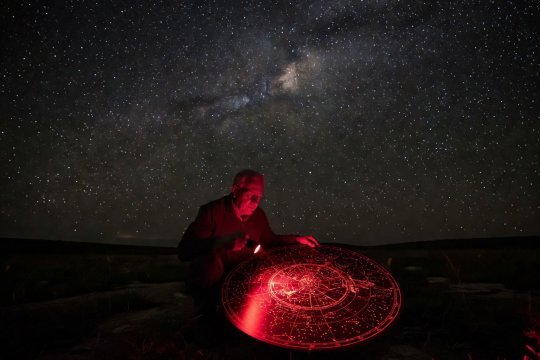
Observing is an acquired physiological skill. You are training both optical rod cells in your retina and mental cognitive pathways to detect subtle contrasts and structural details at the threshold of vision.
THE DISCIPLINE OF STAR-HOPPING
Star-hopping is the classic method of locating deep-sky targets by jumping along lines and triangles of visible stars. You begin at a prominent naked-eye anchor star, look through your low-power finder, match the geometric pattern to your paper chart or red-screen planetarium app, and step by step guide your optical axis to the target.
For example, to find the Ring Nebula (M57) in Lyra, find Vega high overhead in summer. Trace the compact parallelogram of Lyra down to the bottom two stars, Sheliak and Sulafat. Aim your finder directly midway between them. At low power in your main eyepiece, the tiny smoky doughnut of M57 appears centered immediately.
Averted Vision Technique
The center of your eye (the fovea) is packed with color-sensing cones that are almost blind in dim light. When looking at faint galaxies, do not look directly at them. Look 10 to 15 degrees to the side. The light falls on peripheral rod cells, causing the faint target to instantly snap into view.
THE MAJOR METEOR CALENDAR
A meteor shower happens when Earth passes through dusty orbital trails shed by comets or eccentric asteroids. The particles—often no larger than a grain of sand—vaporize in the upper mesosphere at speeds between 20 and 70 kilometers per second.
To maximize meteor counts, observe between 1:00 AM and astronomical dawn when your local geographic horizon rotates into the head-on direction of Earth's orbital path. Recline completely flat on an insulated camp cot to avoid neck strain.
How to photograph meteor fireballs →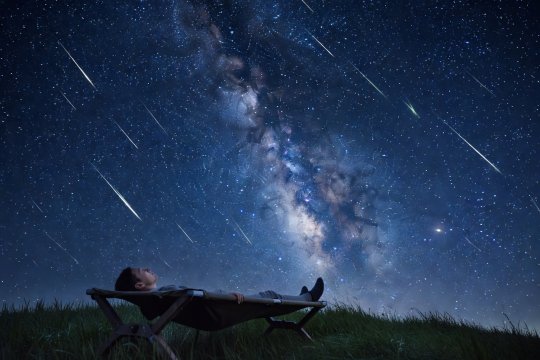
ANNUAL METEOR SHOWER MATRIX
Key annual meteor showers, parent bodies, and peak observational windows.
| Shower Name | Peak Date Window | Parent Body | Expected Zenith Hourly Rate (ZHR) | Observing Characteristics |
|---|---|---|---|---|
| Quadrantids | January 3 – 4 | Asteroid 2003 EH1 | 80 – 120 | Very sharp peak lasting only ~6 hours; bright fireballs. |
| Lyrids | April 21 – 22 | Comet C/1861 G1 Thatcher | 15 – 20 | Fast meteors with persistent glowing vapor trains. |
| Perseids | August 11 – 13 | Comet 109P/Swift-Tuttle | 75 – 100 | Warm summer nights; high velocity (59 km/s); frequent fireballs. |
| Orionids | October 20 – 22 | Comet 1P/Halley | 20 – 25 | Fast strikes; radiating near Orion's raised club. |
| Leonids | November 16 – 18 | Comet 55P/Tempel-Tuttle | 15 – 20 | Extremely fast (71 km/s); historical cyclonic storms every 33 years. |
| Geminids | December 13 – 14 | Asteroid 3200 Phaethon | 120 – 150 | Dense, rocky particles; slower burn; visible before midnight. |
FOUR SEASONS OF THE NORTHERN SKY
Anchor your eyes to one master constellation per season, and the surrounding star patterns fall naturally into place.
URSA MAJOR & BOÖTES
Arc from the Big Dipper's handle to orange Arcturus, then speed on to blue-white Spica in Virgo. This celestial highway opens the realm of thousands of distant springtime galaxies.
THE SUMMER TRIANGLE
Deneb in Cygnus, Vega in Lyra, and Altair in Aquila form an unmistakable overhead isosceles triangle framing the dense star clouds of the Cygnus Rift.
THE GREAT SQUARE OF PEGASUS
A massive four-star quadrangle high in the south. The upper-left corner star (Alpheratz) connects directly to Andromeda, leading your eye to galaxy M31.
ORION & CANIS MAJOR
The crown jewel of visual astronomy. Betelgeuse, Rigel, and the three belt stars guide your glance south to Sirius, the brightest star in Earth's entire night sky.