FROM FIRST EXPOSURE TO FINISHED FRAME
Astrophotography is essentially the science of managing noise. Because silicon camera sensors accumulate thermal patterns, readout artifacts, and random photon fluctuations alongside legitimate deep space light, capturing breathtaking space imagery requires a disciplined, methodical pipeline.
We champion the progressive pathway: master fixed-tripod widefield shots first, graduate to portable motorized tracking mounts, and only then invest in autoguided deep-sky telescope rigs.
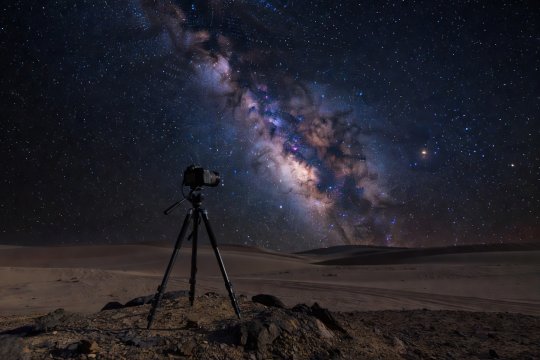
THE RULE OF NPF & UNTRACKED EXPOSURES
Because the Earth rotates once every 23 hours, 56 minutes, and 4 seconds, stars will quickly trail across your sensor if your camera is stationary. The classical "500 Rule" (500 divided by focal length = maximum exposure seconds) is too generous for modern high-megapixel sensors.
Instead, modern shooters use the stricter NPF Rule, which takes pixel pitch, aperture, and target declination into account. For a 24mm f/2.8 lens on a full-frame body, your untracked exposure threshold is typically between 8 and 12 seconds before pinprick stars begin turning into slight oblong dashes.
Fixed Tripod Stack Secret
You can take forty 10-second exposures on a standard stationary tripod, align the stars in free stacking software (such as DeepSkyStacker or Siril), and produce crisp images with dramatically suppressed grain.
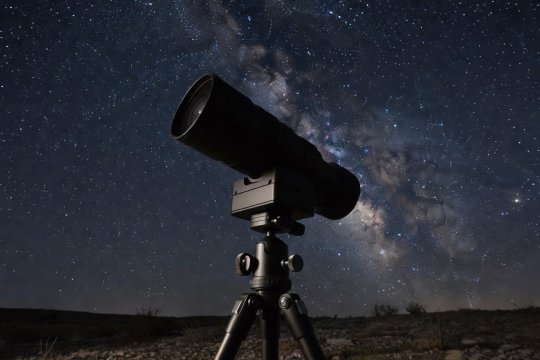
THE STAR TRACKER REVOLUTION
A compact star tracker sits between your tripod and your camera. Once accurately aligned with the celestial pole (Polaris in the north, or the Octans asterism in the south), the internal motor turns the camera at the exact sidereal rate, cancelling Earth's rotation.
With an entry star tracker, your exposures can jump from 10 seconds to 180 or 300 seconds without trailing. This lower ISO requirement reveals subtle emission nebulosity, ionized hydrogen clouds, and dark dust filaments otherwise completely invisible to human eyes.
THE FOUR ESSENTIAL CALIBRATION FRAMES
To extract pure astronomical signals, mathematical subtraction of sensor imperfections is essential.
| Frame Type | How to Capture | Sensor Defect Corrected | Timing & Temperature Rules |
|---|---|---|---|
| Lights (Light Frames) | Standard exposures of the celestial target through optics. | Collects the actual photon signal from the cosmos. | Match exposure length, ISO/gain, and focus precisely. |
| Darks (Dark Frames) | Lens cap ON, exact same shutter speed and sensor temperature. | Thermal sensor noise, hot pixels, fixed-pattern noise. | Must match ambient sensor temp of lights within ±1°C. |
| Flats (Flat Frames) | Evenly illuminated diffuse white surface (white T-shirt/tablet). | Optical vignetting, dust donuts on glass, field curvature unevenness. | Histogram peak at 40–50%; never move optical focus before flats. |
| Biases (Bias Frames) | Lens cap ON, fastest possible mechanical/electronic shutter speed (e.g. 1/4000s). | Base sensor readout noise and sensor line architecture artifacts. | Can be taken anytime at same ISO/gain; library lasts months. |
THE DIGITAL STACKING WORKFLOW
Raw camera captures straight off an SD card look muddy, green-tinted, and flat. This is completely normal: astronomical data is linear, meaning photons have been counted proportionately without consumer camera contrast curves.
The standard processing chain follows five clean steps:
Subtracting darks/biases, dividing flats, and converting raw Bayer sensor matrices into true full-color RGB files.
Detecting thousands of star coordinates across frames and mathematically averaging pixels using kappa-sigma clipping to delete airplane trails and satellite streaks.
Removing atmospheric light pollution gradients and setting black point neutral balances using photometric star color catalogs.
Gently pulling the faint nebulosity out of the darkness while protecting tiny star cores from blooming into harsh white circles.