MATCH THE INSTRUMENT TO THE NIGHT
Telescope catalogs are filled with inflated magnification claims ("675x zoom!") and flimsy plastic tripods that shake at the slightest breath of wind. Real astronomy is built upon light gathering power (aperture), optical quality, and rock-solid mechanical stability.
Before purchasing any tube, an observer must answer three questions: Where will you store it? How heavy an assembly will you willingly carry into the dark? And do you intend to look with human eyes or attach camera sensors?
THE NEWTONIAN DOBSONIAN
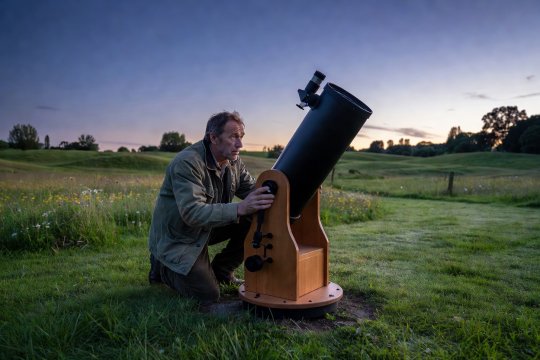
Created by John Dobson in the late 1960s, the Dobsonian remains the undisputed king of aperture-per-dollar. It uses a parabolic primary mirror at the bottom of the tube reflecting light up to a flat diagonal secondary mirror, directing the focal point out the side.
Because the mount is a straightforward wooden alt-azimuth box riding on Teflon and laminate bearings, nearly 90% of your budget goes directly into the glass mirror. An 8-inch (200mm) Dobsonian collects roughly 840 times more light than the naked eye, resolving spiral arms in nearby galaxies and resolving globular clusters into thousands of individual stellar specks.
Observer Note: Collimation Reality
Reflectors require optical alignment (collimation) every few outings using a simple laser collimator or Cheshire eyepiece. It takes ninety seconds once practiced, but it is a required maintenance routine.
REFRACTORS & COMPOUND TUBES
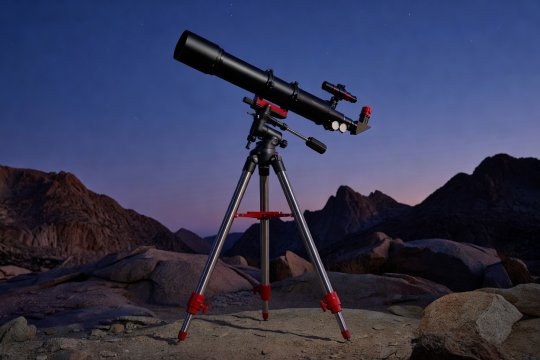
Refractors utilize objective lens elements at the front of a sealed tube. Doublet achromats offer good entry-level planetary views, while triplet apochromats (ED glass) completely eliminate false color fringing (chromatic aberration), rendering razor-sharp planetary disks, pristine lunar shadows, and deep split double stars.
For observers limited by apartment balconies or compact trunk space, Schmidt-Cassegrain (SCT) or Maksutov-Cassegrain designs fold long focal lengths inside very short barrels using internal mirrors and corrector plates. A 6-inch Maksutov delivers outstanding high-magnification planetary performance in an enclosure shorter than a loaf of bread.
OPTICAL DESIGN COMPARISON BENCHMARK
A reference comparison of standard entry-to-intermediate optical designs for visual astronomy.
| Design Type | Typical Aperture | Primary Strengths | Trade-Offs & Caveats | Ideal Observer |
|---|---|---|---|---|
| 7x50 / 10x50 Binoculars | 50 mm | Wide field of view (6°+), zero setup time, stereo vision, extremely portable. | Low magnification; cannot resolve planetary discs or close doubles. | Beginners, travelers, star-cluster lovers. |
| Dobsonian Reflector | 150 mm – 250 mm | Maximum aperture per cost; magnificent deep sky views; intuitive point-and-look mount. | Bulky tube, manual tracking at high powers, regular collimation needed. | Visual deep-sky enthusiasts with vehicle trunk space. |
| ED Triplet Refractor | 70 mm – 102 mm | Zero chromatic aberration; tack-sharp stars; sealed tube; rapid cool-down. | High cost per millimeter of aperture; limited light gathering for faint galaxies. | Planetary and double-star observers, astrophotographers. |
| Schmidt-Cassegrain (SCT) | 150 mm – 200 mm | Very compact tube length; long focal length for planets; versatile accessory ecosystem. | Prone to dew on corrector lens; narrow field of view; slower thermal cooling. | Generalists wanting a do-it-all portable motorized setup. |
THE GEAR THAT ACTUALLY MATTERS
When newcomers struggle, it is seldom the main objective lens at fault. It is usually inadequate eyepieces, unstable finder scopes, or cold fogging optics.
PLÖSSL VS. WIDE-FIELD 82°
Stock eyepieces included with beginner scopes often feature tiny eye relief. Upgrading to a quality 68° or 82° wide-field eyepiece makes looking into the cosmos feel like peering out an open spacecraft window rather than down a drinking straw.
TELRAD & ZERO-POWER FINDERS
Traditional small finderscopes display inverted, magnified images that disorient beginners. A Telrad or red-dot finder projects illuminated bulls-eye rings directly onto the actual sky, making star-hopping effortless.
DEW HEATERS & SHROUDS
On damp autumn nights, radiating optics cool below the ambient dew point, instantly fogging lenses. A 12V dew heater strip or a DIY foam dew shield preserves crystal-clear glass through midnight.